

With the rapid development of the semiconductor industry, chip manufacturing processes have surpassed the 3nm and even 2nm nodes. Improving device performance increasingly relies on micro-level precision machining. As a core component of semiconductor manufacturing, the quality of component surface treatment directly impacts the device's electrical performance, reliability, and service life. Strong magnetic polishers, with their unique non-contact polishing mechanism and ultra-precision machining capabilities, are becoming a rising star in the field of semiconductor component surface treatment. This article will delve into the principles, advantages, and application value of this equipment, revealing its critical role in semiconductor precision manufacturing.
The surface quality of semiconductor components (such as silicon wafers, ceramic substrates, Metal packages, and MEMS devices) is a key indicator of chip yield and performance. For example, silicon wafers must maintain a surface roughness of nanometers (Ra < 1nm) and be free of scratches, residual particles, or microscopic defects. Even the slightest unevenness can lead to stress concentration during wafer processing, photolithography offset, and even device leakage and failure. While traditional surface treatment technologies (such as mechanical polishing, chemical mechanical polishing (CMP), and chemical etching) can meet some needs, they have significant limitations:
? Mechanical polishing: Relying on contact and friction between a hard grinding head and the workpiece, it can easily cause edge collapse or subsurface damage (SSD), making it difficult to process complex curved surfaces or thin parts.
? CMP: Requires the use of a slurry of chemical etching fluid and abrasive, which can easily introduce contaminants and has poor compatibility with non-metallic materials (such as ceramics).
? Chemical etching: Surface topography is difficult to precisely control, resulting in inconsistent results and high waste disposal costs.
Against this backdrop, high-pressure Magnetic polishing machines, with their "non-contact, highly controllable, and minimal damage" characteristics, offer a breakthrough solution for ultra-precision surface treatment of semiconductor components.
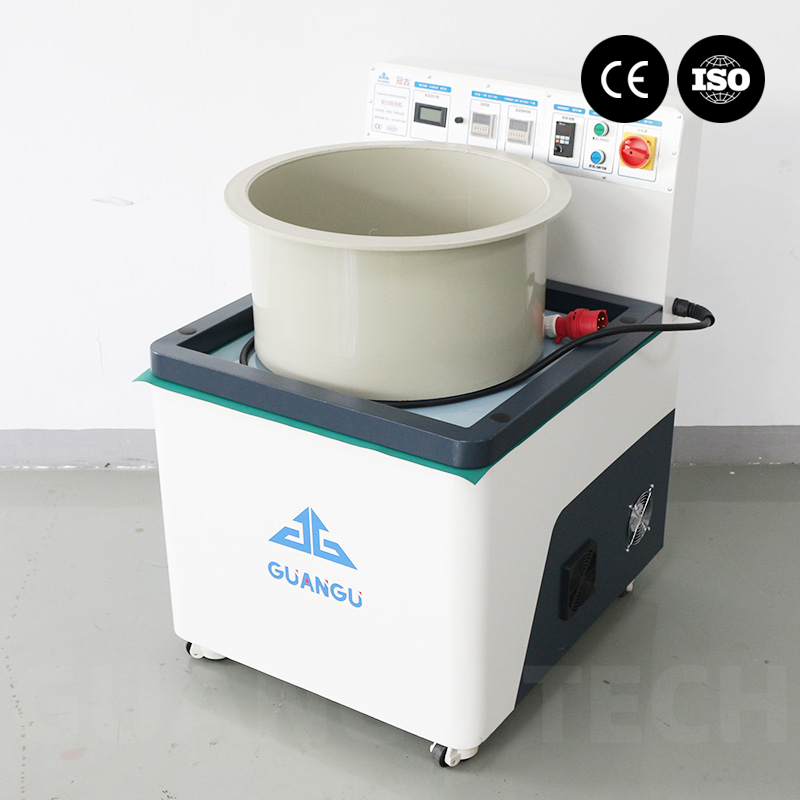
The core principle of high-pressure magnetic polishing machines is to use a strong magnetic field to manipulate magnetic abrasives, forming a flexible grinding layer that performs micro-cutting and extrusion polishing on the workpiece surface. Its technical architecture can be broken down into four major modules:
1. Magnetic Field Generator: The "Invisible Hand" of Precision Control
The equipment is equipped with high-power electromagnets or permanent magnet arrays, and the magnetic field intensity (up to several Teslas) and distribution pattern (e.g., gradient magnetic field, rotating magnetic field) are adjusted in real time by a computer. The dynamic changes in the magnetic field directly determine the trajectory of the abrasive—it can form an "abrasive cloud" that evenly covers the workpiece, or focus on a localized area for targeted polishing.
2. Abrasive System: A Customizable "Nano-Scale Tool"
Magnetic abrasives are typically made of Fe-based alloy particles (such as FeCo and FeNi) coated with an abrasive core such as SiC or Al?O?. Particle size ranges from 5-20μm (adjustable to meet specific requirements). Surface modification technology allows the abrasive to selectively adhere to the workpiece surface, minimizing interference with non-processing areas.
3. Workholding and Motion System: A Multi-Dimensional "Positioning Expert"
To address the diverse needs of semiconductor parts (such as thin wafers, special-shaped parts, and small chips), the equipment is equipped with vacuum adsorption, electrostatic clamping, or air flotation platforms, coupled with a six-axis robotic arm to achieve ±1μm positioning accuracy, ensuring uniform polishing of complex curved surfaces.
4. Intelligent Monitoring and Closed-Loop Feedback: A Data-Driven "Quality Steward"
Integrated online inspection modules such as a laser thickness gauge and surface profilometer monitor workpiece surface roughness, removal volume, and other parameters in real time. AI algorithms are used to optimize magnetic field parameters and abrasive supply to ensure consistent processing.
Compared to traditional technologies, high-pressure magnetic polishers demonstrate irreplaceable value in semiconductor part processing:
1. Ultra-Precision: Nanoscale Surface Quality, Zero Subsurface Damage
The magnetic field-driven flexible grinding layer eliminates rigid contact, reducing workpiece surface roughness to Ra <0.5nm and subsurface damage depth to <1μm (compared to 5-10μm for traditional mechanical polishing). This is crucial for the contact surfaces between heat sinks and electrodes in high-frequency devices and power semiconductors.
2. High Compatibility: Adaptable to all materials and shapes
Whether it's hard and brittle materials like silicon, silicon carbide (SiC), and gallium nitride (GaN), or metals like copper, aluminum, and stainless steel, or even ceramic and polymer composites, high-pressure magnetic polishers can achieve efficient polishing by adjusting magnetic field parameters and abrasive formulations. For special-shaped structures like TSVs and micro-bumps in 3D packaging, their non-contact nature eliminates the edge over-polishing problem associated with traditional processes.
3. High Efficiency and Low Cost: Shorten process cycles and reduce overall costs
High-pressure magnetic polishing utilizes a "dry" or "minimum quantity lubrication" method, eliminating the need for chemical slurries and reducing waste disposal costs. Furthermore, the magnetic field-driven abrasive recycle rate can exceed 90% (compared to traditional CMP slurries, which can only be used once or twice). Field data from a leading wafer fab shows that using high-pressure magnetic polishers has increased the yield of silicon wafer edge polishing from 92% to 98%, while reducing batch processing time by 40%.
4. Green and Safe: Complies with the ESG requirements of the semiconductor industry
The design, which eliminates the need for chemical reagents, offers low noise (<65dB), and low dust emissions, making it easier to pass semiconductor cleanroom (Class 10/Class 1) environmental certifications, helping companies achieve green manufacturing.
The flexibility of high-pressure magnetic polishers enables them to play a key role in multiple stages of semiconductor manufacturing:
? Wafer Manufacturing: Surface polishing after backside thinning of silicon wafers (to reduce warpage) and planarizing the buried oxide layer of SOI wafers;
? Power Devices: Post-solder surface treatment of copper substrates and DBC ceramic substrates for IGBT modules (to remove oxide layers and improve bond strength);
? MEMS Manufacturing: Precision polishing of cantilever beams and cavity structures for accelerometers and gyroscopes (to avoid stress and deformation);
? Advanced Packaging: Post-underfill surface planarization of FC-BGAs (flip-chip ball grid arrays) and sidewall polishing of TSVs in 2.5D/3D ICs (to reduce resistance).
Conclusion: High-pressure magnetic polishers are the "future standard" for semiconductor precision manufacturing.
With the continuation of Moore's Law and the advancement of heterogeneous integration technology, the surface treatment of semiconductor components has evolved from a "qualified line" to a "competitive line." Strong magnetic polishers, with their precise micromorphology control capabilities, universal compatibility across materials, and support for green manufacturing, are gradually moving from the laboratory to large-scale production lines.
For semiconductor companies, the introduction of strong magnetic polishers is not only an equipment upgrade but also a leap forward in process capabilities. They not only improve yield and reduce costs, but also provide critical support for the development of advanced processes such as chiplets and quantum chips. In the semiconductor era where "precision is value," strong magnetic polishers will undoubtedly become the "invisible guardian" of precision manufacturing, propelling the industry to higher dimensions.